
AI and Human Judgment: What Leaders Need to Know
How can leaders use AI without outsourcing human judgment?
Leaders can use AI wisely by automating low-stakes, reversible work while keeping people involved when decisions require purpose, interpretation, context, or an understanding of consequences. The goal isn’t to keep a human involved in every task. It’s to know where human judgment actually matters.
That distinction is getting harder to make.
AI can give us an answer in seconds. And that answer can sound remarkably confident, even when it’s wrong.
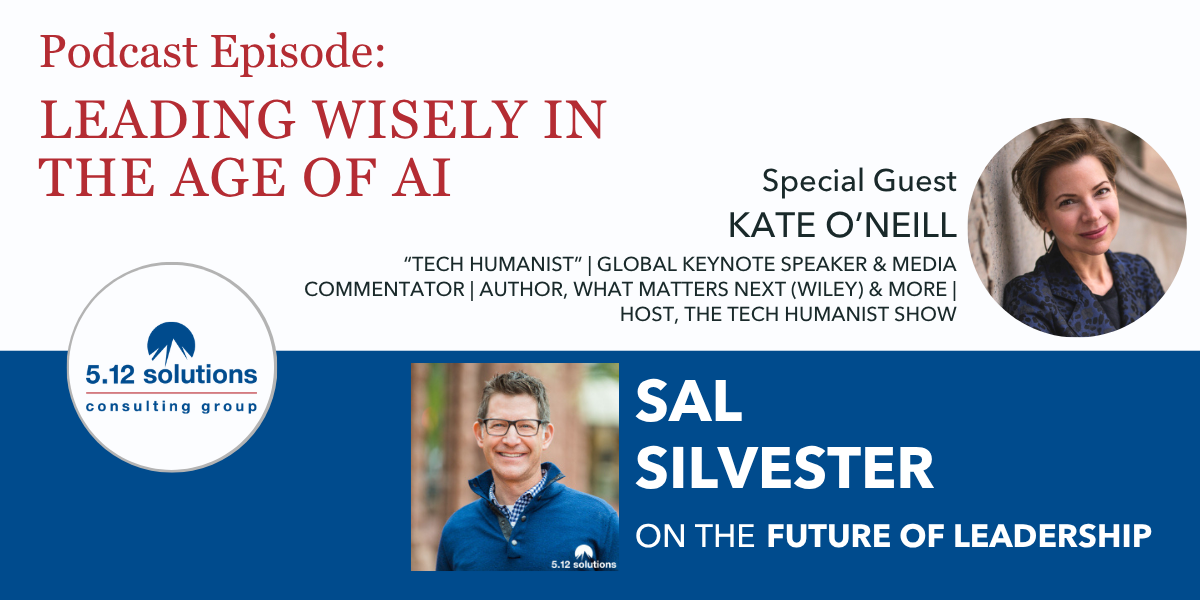
In a recent conversation on the Future of Leadership Podcast, I spoke with tech humanist and author Kate O’Neill about something she calls AI’s “certainty theater.”
I love that phrase.
Because when a tool sounds certain, we’re more likely to trust it. And if we’re not careful, human oversight becomes little more than a rubber stamp.
Why AI Still Needs Human Judgment
Kate made an important distinction during our conversation: AI recommendations are based on probability. They aren’t based on wisdom, lived experience, or a deep understanding of your organization’s strategy.
As Kate put it, “We cannot leave it up to machines to determine what matters”
That responsibility still belongs to us.
It’s also why I’m skeptical when I hear organizations talk about becoming “AI-first.”
First should come purpose.
What are we trying to accomplish? What value are we trying to create? What experience do we want our employees and customers to have?
Then we can ask where AI helps us get there faster or more effectively.
What Should Leaders Automate With AI?
One of the most practical ideas Kate shared was to look for low-regret automation.
In other words, automate work where the stakes are low, the decision is reversible, and getting something wrong won’t create significant consequences.
A weekly report that someone manually generates every Monday? Great candidate.
A consequential decision affecting an employee or customer? Think much harder.
As leaders, we should keep humans meaningfully involved when:
- The decision connects directly to organizational purpose or strategy.
- Context and interpretation matter.
- An exception falls outside the normal pattern.
- The consequences of getting it wrong are significant.
- Someone may need recourse if a decision creates harm or an unintended outcome.
That’s a much higher bar than simply putting a person at the end of an AI-enabled process and asking them to click “approve.”
Why AI and Human Judgment Depend on a Speak-Up Culture
There’s another piece of this conversation that leaders can’t ignore.
You can build all the human checkpoints you want, but they won’t do much good if your people are unwilling to challenge the output.
Meaningful human oversight requires people who ask, “Does this actually make sense?” It requires people who challenge assumptions, surface a different perspective, and push back when something doesn’t align with the purpose.
That takes productive conflict.
And as AI becomes more embedded in how organizations operate, I think that distinctly human capability becomes even more valuable.
How AI Can Strengthen Human Contribution
AI can absolutely make us faster. It can identify patterns, handle routine work, and give people a starting point for deeper thinking.
But faster isn’t the same as better.
The opportunity for leaders is to use AI to free people from lower-value work so they have more capacity for the work humans are uniquely positioned to do: interpret, question, imagine consequences, build relationships, and make meaning.
The question isn’t simply, “Can AI do this?”
Ask a better one:
“Should AI do this, and where does human judgment need to remain?”
Help Your Team Challenge Ideas Productively
Human judgment only works when people are willing to use it.
Our free Productive Conflict Toolkit gives you practical tools to help your team challenge assumptions, surface different perspectives, and engage in the conversations that lead to better decisions.
Download the free Productive Conflict Toolkit and give your team a better way to challenge thinking when it matters.
Organizational Change FAQs
What does “human in the loop” mean with AI?
It means humans remain meaningfully involved in reviewing or making decisions where purpose, context, interpretation, consequences, or exceptions matter. It should involve real judgment, not simply approving what AI recommends.
What tasks are safest to automate with AI?
Start with low-stakes, reversible, low-regret work. Routine reports and other repetitive tasks can be strong candidates when mistakes are easy to identify and correct.
Why shouldn’t companies become “AI-first”?
Because technology should follow purpose and strategy. Leaders should first determine what the organization is trying to accomplish, then decide where AI can help advance those goals.
How can leaders prevent employees from rubber-stamping AI output?
Create an environment where questioning assumptions and disagreeing productively are expected. Give people clear responsibility for interpreting AI output and considering the consequences before acting on it.