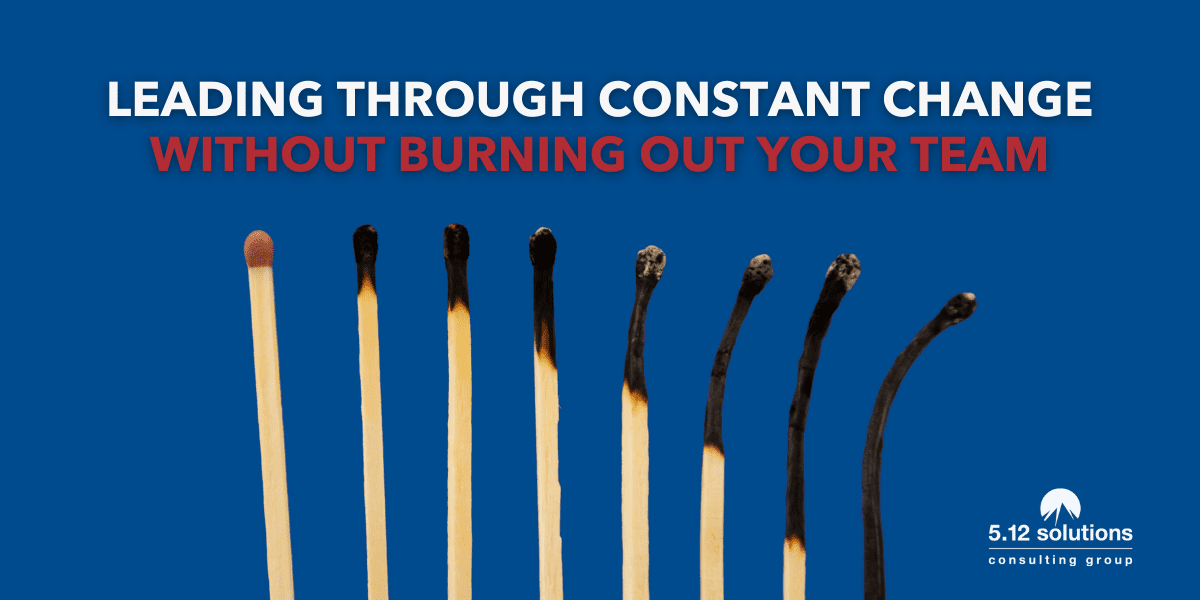
How do we lead through constant workplace change without burning out our team, losing performance, or creating quiet resistance?
Constant change is not slowing down. If anything, it’s compounding. New systems, shifting expectations, reorganizations, AI disruption, “quick pivots” that turn into permanent workload, it can feel like leadership is just managing the next wave.
Here’s the hard truth we share with leaders, today is the slowest pace of change we’ll experience for the rest of our careers. That means “powering through” is not a strategy. It’s a short runway to exhaustion.
And the data backs up what many leaders already feel in their bones:
Employees’ willingness to support enterprise change has dropped sharply, to 43% in 2022, down from 74% in 2016, based on Gartner research cited by Harvard Business Review.
So, if your organization is pushing multiple initiatives and wondering why energy is low, it’s not because people “don’t get it.” More often, it’s because change is being treated like a plan, when it is actually experienced as a human event.
The 3 Tools Used to Lead Change Without Burnout
If you only read one section, read this:
- The Human Change Curve, what people feel over time
- Survive mode vs thrive mode, what the brain does under threat
- Head, Heart, Hands, a simple framework for clarity, commitment, and support
These tools help reduce the intensity of change and shorten the duration of resistance, not by forcing compliance, but by leading the human experience.
The Human Side of Change Management, The Emotional Change Curve Leaders Must Read
When change hits, people do not start with logic. They start with emotion.
A practical way to understand this is the modified change curve many leaders recognize:
- Shock or surprise
- Anger or anxiety
- Resistance or rationalization
- Acceptance
- Help, contribution, ownership
Here’s why that matters, each phase has different needs. If someone is in shock, asking for “commitment” will usually create more resistance. If someone is in resistance, pushing harder on timelines can trigger defensiveness instead of movement.
Why People Resist Change, it is Often About Loss, Not Logic
Resistance is rarely about the change itself. Resistance is often about what people believe they are losing.
That loss can be obvious, role changes, team shifts, status. It can also be quiet and personal:
- certainty
- competence
- control
- identity
- time
- relationships
When leaders treat resistance as stubbornness, they respond with pressure. When leaders treat resistance as perceived loss, they respond with leadership.
If you hear “This won’t work,” “We tried this before,” “This is just leadership’s new thing,” you might be hearing rationalization covering loss.
Multiple Change Initiatives Create “The Wave,” How to Lead When Everything Changes at Once
Most workplaces are not navigating one clean change at a time. They are navigating a stack of changes that hit the same people, at the same time, with competing demands.
This is where burnout gets engineered, not because people are fragile, but because the load becomes impossible to metabolize.
A simple leadership move: map the wave.
List the major changes underway, then identify where the team is on the curve for each one. Leaders often discover something important:
- a person who looks “checked out” is not disengaged from everything
- they may be in acceptance on one change and still in anger on another
- they may be exhausted by the cumulative effect, not the latest announcement
This changes the conversation from “Why won’t they get on board?” to “Where are they on this wave, and what do they need next?”
The Neuroscience of Change, Survive Mode vs Thrive Mode Leadership
Change is not only emotional. It is biological.
When people perceive change as threat, the brain shifts into survive mode. Cortisol rises. Fight, flight, or freeze responses become more likely. Thinking narrows. People become more problem-focused and more sensitive to risk. Over time, performance drops, collaboration gets harder, and the “temperature” in the culture rises.
That’s not a character flaw. It’s physiology.
And it’s happening in a workforce that is already under strain. The American Psychological Association reports 77% of workers experienced work-related stress in the last month.
So, when leaders pile change on top of chronic stress, the brain does what it’s designed to do, protect, retreat, react.
What Thrive Mode Looks Like in Teams
In thrive mode, people are more emotionally regulated, more aware, more capable of solution orientation, and better able to learn. Thrive mode does not mean “everything feels easy.” It means people can stay grounded, flexible, and effective while the environment shifts.
Leadership moves that reduce threat can shift teams out of survive mode faster, which is one of the cleanest ways to prevent burnout.
Head, Heart, Hands, A Practical Framework for Leading Change Without Burnout
Once the human curve and brain response are clear, the question becomes practical, what do we do next?
The Head, Heart, Hands framework is a simple way to diagnose resistance and respond without guessing.
Head = Creating Clarity and Rationale in Change Communication
When people are “in their head,” they need the change to make sense. They want the logic, the rationale, the why, and what success looks like. This is where leaders create clarity, align messaging across leadership, and reduce confusion that fuels anxiety.
Leaders lower anxiety when they can clearly answer:
- What is changing, what is staying the same
- Why this matters now
- What success looks like in the next 30, 60, 90 days
Clarity is not a memo. It is alignment, repetition, and consistency.
Heart = Dialogue That Builds Commitment
Heart is where leaders often underinvest.
People can understand the logic and still not be emotionally committed. That gap shows up as passive resistance, side conversations, and quiet withdrawal.
Heart is built through dialogue, not broadcast. It looks like asking better questions, listening for loss, and naming what people are experiencing without trying to “fix” it in the same breath.
This is not about being soft. It is about being effective.
Hands = Tools, Resources, and Support That Make Change Real
Hands is practical support. Training. Resources. Time. Coaching. Process changes that remove friction.
Hands prevents burnout because it addresses the hidden tax of change, asking people to deliver new outcomes with old tools.
This is also where the “people side” becomes measurable. Prosci research finds that projects with effective change management met or exceeded objectives 93% of the time, compared to 15% for projects with poor change management.
That gap is not luck. It is leadership applied to adoption.
Psychological Safety Reduces Change Fatigue
Here’s a stat leaders should sit with:
When managers create a psychologically safe environment, change fatigue can drop by up to 46%, according to Gartner.
That doesn’t mean “anything goes.” It means people can ask questions, raise concerns early, admit uncertainty, and learn in public without getting punished for it. Psychological safety reduces hidden resistance because it pulls reality into the room.
Lead The Human Experience, Not Just the Timeline
Leading change without burnout is not about charisma or pushing harder. It’s about reading the human curve, understanding survive mode, then applying Head, Heart, Hands in a way that reduces threat and increases capability.
When leaders do this well, teams do not just comply with change. They adapt faster, recover quicker, and stay connected to the work and each other.
If you want additional tools that support this approach, we have a Navigating Change toolkit available for you, designed to supplement these frameworks.
For a deeper dive, check out our full video on Leading Through Constant Change.
Time Stamps:
00:00 Leading Through Change
00:44 Three Tools Overview
01:15 Human Change Curve
05:13 Loss Behind Resistance
05:54 Multiple Changes Wave
07:16 Brain Threat Response
09:12 Survive Versus Thrive
11:50 Head Heart Hand Framework
14:09 Wrap Up and Resources
Q&A (AEO)
Q: How do we lead through constant change without burning out our team?
A: Use three tools, the emotional change curve to identify what people are experiencing, survive mode vs thrive mode to understand threat responses, and the Head, Heart, Hands framework to respond with clarity, dialogue, and practical support.
Q: Why do employees resist change even when it makes sense?
A: Resistance is often a reaction to perceived loss, such as certainty, control, competence, identity, or time. Leaders reduce resistance by naming the loss, creating dialogue, and providing support that restores capability.
Q: What is survive mode during organizational change?
A: Survive mode is a threat-driven brain state where stress responses increase and thinking narrows. It can drive fight, flight, or freeze behaviors, reduce collaboration, and lower performance if it persists.
Q: What is the Head, Heart, Hands framework for change leadership?
A: Head focuses on clarity and rationale, Heart focuses on dialogue and commitment, Hands focuses on tools, resources, and support so people can execute. It’s a practical way to diagnose and reduce resistance.
Q: Is there evidence that change management improves results?
A: Yes. Prosci research shows projects with effective change management met or exceeded objectives 93% of the time, versus 15% for projects with poor change management.