
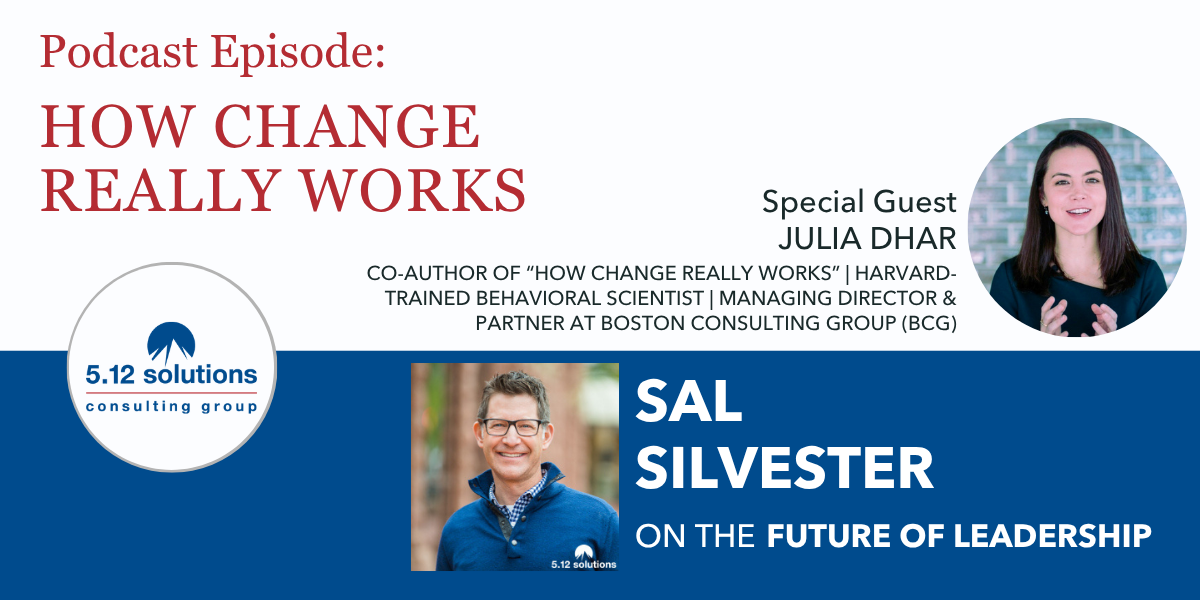
Why do organizational change efforts fail?
Organizational change often fails because leaders assume people resist change, when the real problem may be how the change is designed, communicated, and experienced. Successful transformation requires leaders to understand that experience, create true agreement, and stay engaged long after the kickoff.
That’s what we explored with behavioral scientist Julia Dhar, co-author of How Change Really Works.
And Julia challenged a deeply embedded assumption: People don’t necessarily resist change. They resist being changed.
Why Employees Resist Organizational Change
Julia and her colleagues studied 6,000 people around the world and found something surprising. More than half of employees felt positively about the prospect of change. Executives were even more optimistic.
Julia calls the gap between those perspectives change distance.
Executives often have more control over the pace, sequencing, and decisions surrounding a transformation. Employees may experience the same change with far less context or agency.
That should change how we think about resistance.
Julia shared the story of psychologist Paul Fitts, who studied why highly trained fighter pilots were crashing advanced military aircraft. The problem wasn’t the pilots. The cockpit environment wasn’t designed around the humans operating it.
There’s a powerful parallel for leaders.
Before blaming people for resisting change, examine the environment we’ve created for them.
That means asking:
- Do people have real agency in how this change happens?
- Are we asking employees what would make the change work?
- Have leaders reached true agreement on priorities?
- Are we still paying attention during the “messy middle,” when implementation gets difficult?
Julia also offered a deceptively simple question leaders can ask when change seems to be struggling:
“Do you think we are likely to be successful with the goals we have set out?”
Then listen.
Because organizations are full of both facts and feelings. We need access to both.
Successful transformation isn’t about getting people to stop resisting. It’s about getting closer to their experience, understanding what the environment is asking of them, and being willing to change how we lead change.
Leading Change? Close the Gap Between Strategy and Experience.
Download our free Navigating Change Toolkit for practical frameworks to help you understand how people experience change, create greater clarity and certainty, and lead your team through uncertainty with intention.
📌 Access your free toolkit today.
Organizational Change FAQs
Do employees really resist change?
Not necessarily. Research found more than half of employees had a positive orientation toward change. Resistance may have more to do with how people are being asked to change than change itself.
What is change distance?
Change distance is the gap between how executives and employees experience change. Leaders often have greater context, control, and time to process a transformation.
How can leaders improve organizational change efforts?
Get evidence about what is actually happening, ask employees whether they believe the change will succeed, create true agreement around priorities, and stay actively engaged through implementation.