
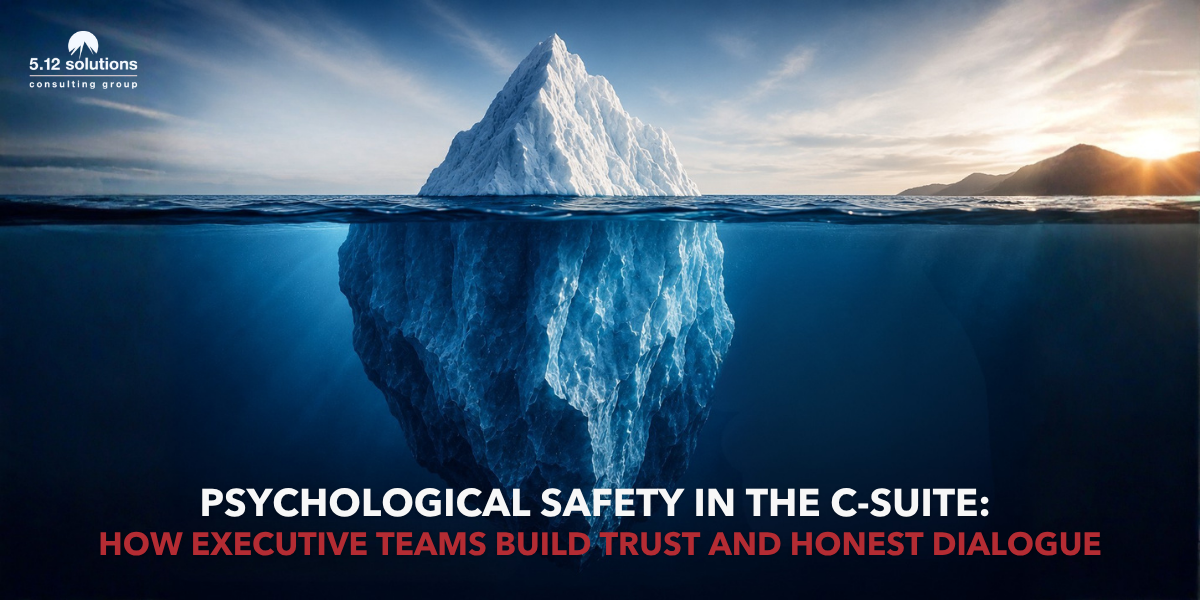
What Is Psychological Safety in the C-Suite?
Psychological safety in the C-suite is the shared belief that executive leaders can speak openly, challenge assumptions, admit mistakes, and raise concerns without fear of embarrassment, punishment, or damage to their reputation. High-performing leadership teams create psychological safety to encourage honest dialogue, improve decision-making, strengthen trust, and navigate complexity more effectively.
Organizations with psychologically safe leadership teams are more likely to surface risks early, make faster decisions, foster innovation, and build cultures where employees feel heard and valued.
Most executive teams don’t struggle because they lack intelligence.
They struggle because people stop saying what they really think.
The CFO sees a risk but softens the message. The CHRO notices growing frustration across the organization but hesitates to challenge the prevailing narrative. The COO disagrees with a strategic decision but chooses silence over conflict.
On the surface, the leadership team appears aligned.
Underneath, concerns go unspoken, tensions remain unresolved, and critical information never reaches the table.
This is where organizational performance quietly begins to erode.
The highest-performing executive teams understand something many leaders overlook: psychological safety is not a soft skill. It is a business imperative.
The Hidden Cost of Silence
Most executives have experienced it.
A meeting ends. Everyone appears to agree.
Then the real meeting begins.
Conversations happen in hallways, private messages, and closed-door discussions. Questions surface after decisions are made. Doubts emerge when it’s too late to influence the outcome.
The result is slower execution, reduced trust, decision fatigue, and growing organizational friction.
When leaders don’t feel safe speaking candidly, organizations lose access to their most valuable resource: honest information.
The irony is that executive teams are often filled with highly capable, experienced leaders. Yet many operate in environments where protecting relationships feels safer than challenging ideas.
Over time, the desire to avoid discomfort becomes more dangerous than the discomfort itself.
Silence comes with a measurable business cost. Gallup found that when employees strongly agree that their opinions count, organizations experience a 27% reduction in turnover, a 40% reduction in safety incidents, and a 12% increase in productivity. When leaders create environments where people speak up, the payoff extends far beyond team dynamics and directly impacts organizational performance.
Why Psychological Safety Matters for Executive Leadership Teams
Harvard researcher Amy Edmondson defines psychological safety as a shared belief that a team is safe for interpersonal risk-taking.
In practical terms, it means leaders can:
- Challenge assumptions without fear of retaliation
- Admit mistakes without damaging credibility
- Ask difficult questions without being labeled disruptive
- Offer dissenting opinions without risking relationships
- Share concerns before problems become crises
For executive teams, these behaviors are not optional. They are essential.
Complex business environments require leaders to navigate uncertainty, make decisions with incomplete information, and adapt quickly. None of that happens effectively when executives are filtering their perspectives to avoid conflict.
The organizations that adapt fastest are often the ones where leaders can have the most honest conversations.
The challenge is that psychological safety remains surprisingly rare. McKinsey research found that only 26% of leaders create psychological safety for their teams. While many executives say they want transparency and candid feedback, their behaviors often unintentionally signal that disagreement is risky.
How Executive Teams Build Trust Through Productive Conflict
Many leadership teams confuse harmony with health.
They aren’t the same thing.
Healthy teams engage in productive conflict. Unhealthy teams avoid it.
When trust is low, disagreement feels personal. Leaders become defensive. Conversations become political. People advocate for functions instead of enterprise outcomes.
When trust is high, disagreement becomes a tool for better thinking.
Executive teams that perform at a high level create environments where direct, respectful debate is expected. They understand that challenging an idea is not the same as attacking a person.
In fact, avoiding difficult conversations often creates more damage than having them.
The strongest leadership teams don’t eliminate conflict.
They normalize it.
As Patrick Lencioni’s research on cohesive teams demonstrates, trust and productive conflict are foundational to healthy leadership teams. Teams that can engage in direct, honest, and respectful communication make faster decisions, build stronger commitment, and avoid the politics and confusion that derail performance.
What Top Leaders Do Differently
Psychological safety doesn’t happen by accident. It is intentionally created through leadership behavior.
The most effective executives consistently model several key practices.
1 – They Go First
Leaders set the emotional tone of the room.
When executives openly acknowledge mistakes, uncertainty, or blind spots, they signal that vulnerability is acceptable.
When leaders pretend to have all the answers, everyone else feels pressure to do the same.
Humility creates permission.
2 – They Reward Candor
Many leaders claim they want honest feedback.
Far fewer respond well when they receive it.
Psychological safety grows when leaders reward people for raising concerns, identifying risks, and challenging assumptions, even when the message is uncomfortable.
If speaking up leads to embarrassment or dismissal, people quickly learn to stay quiet.
3 – They Separate Ideas from Identity
Strong executive teams debate issues vigorously while maintaining respect for the people involved.
They challenge assumptions, data, and recommendations without attacking character or competence.
This distinction allows leaders to engage fully without becoming defensive.
4 – They Create Clear Team Norms
Healthy teams don’t leave behavior to chance.
They establish clear agreements around how they will communicate, disagree, make decisions, and hold one another accountable.
When expectations are clear, difficult conversations become easier to navigate.
People know the rules of engagement.
The Courage to Hear What You Don’t Want to Hear
One of the greatest tests of leadership is how you respond when someone tells you something you don’t want to hear.
An executive points out a flaw in your strategy.
A team member challenges your assumption.
A colleague questions a decision you’ve already made.
These moments determine whether psychological safety grows or disappears.
Leaders who become defensive may win the argument.
They often lose trust.
The executives who create extraordinary cultures approach these moments differently. They become curious before becoming certain. They ask questions before making judgments.
Most importantly, they recognize that disagreement is often a sign of engagement, not resistance.
The Business Benefits of Psychological Safety in the Workplace
Every organization says it wants innovation, agility, and accountability.

Those outcomes don’t emerge from silence.
They emerge from environments where people feel safe enough to tell the truth.
Employees understand this intuitively. Research shows that 89% of employees recognize psychological safety as essential, only about 47% feel their workplace actually provides it. They know that the ability to challenge assumptions, admit mistakes, ask for help, and contribute ideas without fear creates stronger teams and better outcomes.
The future belongs to organizations that can learn faster, adapt faster, and make better decisions in increasingly complex environments.
That requires leaders who create space for honest dialogue.
Not performative openness.
Not surface-level harmony.
Real conversations.
The kind where concerns are raised early, assumptions are challenged respectfully, and people leave the room aligned because they were heard, not because they stayed silent.
In The Deeply Human Workplace, we wrote about people needing to feel safe enough to take interpersonal risks by expressing new ideas and challenging the status quo. When leaders create that environment, teams become more adaptive, collaborative, and committed to shared outcomes.
Psychological safety is not about making people comfortable.
It’s about creating an environment where truth can surface before problems do.
And in the C-suite, that may be one of the most valuable leadership capabilities of all.
Ready to Build More Honest Conversations on Your Leadership Team?
Psychological safety doesn’t happen by accident.
It is built through trust, productive conflict, and the ability to engage in direct, honest, and respectful dialogue when the stakes are high.
If your leadership team struggles with silence, avoidance, recurring disagreements, or “meetings after the meeting,” our free Productive Conflict Toolkit can help.
Inside, you’ll find practical tools and frameworks to help leaders navigate difficult conversations, build trust, and create healthier team dynamics.
📌Download the Free Productive Conflict Toolkit
FAQs About Psychological Safety in Leadership Teams
Q: Why is psychological safety important for executive teams?
Psychological safety enables executives to have candid conversations about risks, opportunities, and challenges without fear of negative consequences. When leaders feel safe speaking openly, organizations benefit from better decisions, stronger collaboration, increased innovation, and faster execution.
Q: How can leaders create psychological safety in the workplace?
Leaders create psychological safety by encouraging open dialogue, rewarding constructive dissent, admitting mistakes, seeking input from others, and responding to feedback with curiosity rather than defensiveness. Consistently modeling these behaviors signals that honest communication is valued and expected.
Q: What are the signs of low psychological safety on a leadership team?
Common signs include leaders withholding concerns, avoiding difficult conversations, revisiting decisions repeatedly, excessive agreement during meetings followed by disagreement afterward, limited participation, and a reluctance to challenge ideas from senior executives.
Q: What is the relationship between trust and psychological safety?
Trust and psychological safety are closely connected. Trust helps people believe others have positive intentions, while psychological safety creates confidence that speaking up will not result in punishment or humiliation. Together, they enable productive conflict, stronger relationships, and more effective teamwork.