

 Last updated: October 15, 2026
Some leaders walk into a room and instantly earn attention. Others struggle to make their ideas land, even when they’re right. The difference isn’t intelligence or experience. It’s presence.
At 5.12 Solutions, we’ve seen thousands of leaders rise through the ranks only to plateau when competence alone stops being enough. Executive presence is what helps them break through. It’s the ability to project calm confidence, communicate clearly, and connect authentically. And the best part? It’s learnable.
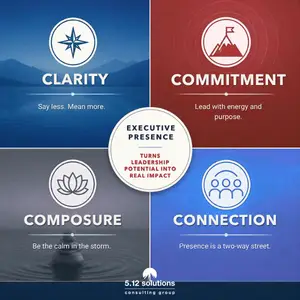
We use a simple, powerful model to help leaders strengthen it: the 4 C’s of Executive Presence – Clarity, Commitment, Composure, and Connection.
#1 – Clarity: Say Less. Mean More.

Clarity is how leaders cut through noise and complexity. It’s the skill that transforms smart ideas into messages people actually remember.
How to build it:
- Start with your main point, then add context
- Use examples and analogies to make concepts stick
- Respect people’s attention. Get to the heart of it fast.
Leaders who master clarity don’t just inform. They align. Their words move people from uncertainty to action.
#2 – Commitment: Lead with Energy and Purpose
Commitment is what makes people believe you believe. It’s not about being loud. It’s about being aligned – your tone, body language, and intention all pointing in the same direction.
Start by knowing your “why,” the root of real authenticity. Use your voice to create energy – shift your pace, pitch, and pause to keep people engaged. Share real stories that show what matters to you and how those values shape the way you lead.
Your conviction gives others permission to care. When you lead with clarity and genuine purpose, people follow with trust.
#3 – Composure: Be the Calm in the Storm
When pressure rises, so does the need for composure. It’s what helps others feel safe, even when uncertainty runs high.
67% of senior executives identify executive presence as essential for leadership success. (Source: Moxie Institute)
How to build it:
- Take a breath before you respond.
- Stay aware of your posture, voice, and expression.
- Notice everyone’s energy – who’s engaged, who’s hesitant, who might need support.
- Shift your focus outward – “What does my team need right now?”
Confidence isn’t the absence of nerves. It’s what happens when you face challenge with steadiness. People don’t just hear composure. They feel it.
Staying grounded when the stakes are high takes practice. Explore why leading through uncertainty begins with understanding your own reactions.
#4 – Connection: Presence Is a Two-Way Street

Presence isn’t performance. It’s making people feel seen, heard, and valued. Part of that is knowing how to read the room – understanding what people need in the moment, adjusting your tone, and meeting them where they are.
That ability to make others feel heard is also central to creating psychological safety, especially on executive teams where honest disagreement can shape better decisions.
So how do you build that kind of presence? Start with curiosity. Listen first, respond second. Take the time to acknowledge contributions and keep your communication conversational and human. Pay attention to nonverbal signals – sometimes connection is built by noticing what isn’t said.
When you focus on connection, leadership shifts from simply holding authority to creating real influence. People don’t just follow; they commit when they feel genuinely connected.
Why Executive Presence Matters More as You Move Up
67% of senior executives identify executive presence as essential for leadership success. (Source: Moxie Institute)
The leadership skills that got you promoted aren’t necessarily the ones that will help you succeed at the next level.
Early in your career, success often comes from technical expertise and individual contributions. But as you move into senior leadership, your impact depends increasingly on your ability to influence decisions, navigate competing priorities, and inspire confidence across the organization.
Your audience changes, too. You’re no longer communicating primarily with your immediate team. You’re engaging executives, peers, and stakeholders who bring different expectations and perspectives.
This requires greater emotional intelligence and the ability to adapt your communication style without compromising your authenticity.
Leadership assessments can help identify where your natural tendencies support your executive presence and where they might hold you back.
Ultimately, effective leadership at higher levels requires a shift in how you think about influence. Your expertise may earn you a seat at the table. Your presence determines how effectively you use it.
Building Presence That Lasts
Executive presence isn’t something you’re born with. It’s developed through awareness, feedback, and practice. Every interaction is an opportunity to strengthen it. We help leaders build presence that lasts through our proven coaching systems and behavioral measurement on Coachmetrix, our proprietary accountability platform.
Because when presence becomes a habit, leadership becomes effortless.
For a practical look at making leadership development stick, explore how to turn leadership goals into measurable behavior change.
Ready to Strengthen Your Executive Presence?
The 4 C’s – Clarity, Commitment, Composure, and Connection – are skills that elevate every aspect of leadership. They make your ideas land… make your confidence real… and make your influence visible.
Dive deeper into the 4 C’s of Executive Presence with our full white paper. Learn practical strategies to strengthen your presence, inspire trust, and elevate your influence.