
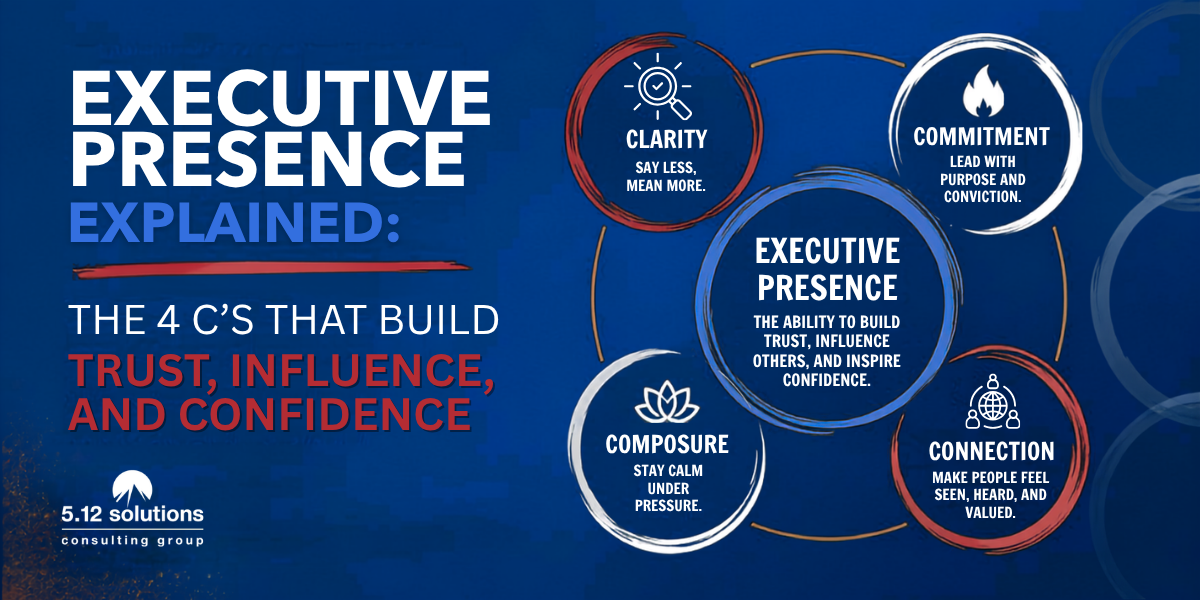
What Is Executive Presence?
Executive Presence is the ability to create trust, influence others, and build confidence in the people around you. It isn’t about charisma, appearance, or having the loudest voice in the room. It’s about how consistently you help others feel confident in your leadership.
The good news? Executive Presence isn’t something you’re born with. It’s a set of behaviors that can be developed through intentional practice.
Watch: Executive Presence Explained in 6 Minutes
Prefer to watch instead of read?
In this short video, Sal Silvester breaks down the 4 C’s of Executive Presence and shares practical examples you can apply in your next meeting, presentation, or difficult conversation.
Or, keep reading for a deeper dive into each of the Four C’s. ⤵️
What If Being Great at Your Job Isn’t Enough?
What if being great at your job isn’t enough to make you a great leader?
It’s a difficult realization for many high-performing professionals.
You’ve worked hard to become an expert. You solve problems. You deliver results. You’re dependable, knowledgeable, and capable.
Then you step into a leadership role and discover something unexpected.
People aren’t looking to you simply because you’re the smartest person in the room.
They’re looking to you because they want confidence.
After coaching leaders around the world for more than 25 years, we’ve found that the leaders people trust most rarely fit the stereotype of the charismatic executive who commands every room.
In fact, many of the strongest leaders we’ve coached are some of the quietest.
They don’t dominate conversations.
They don’t always have the quickest answer.
Instead, they create confidence through how they communicate, how they respond under pressure, and how they make other people feel.
That’s Executive Presence.
Executive Presence Isn’t What Most People Think
Ask ten people to define Executive Presence and you’ll probably hear words like confidence, charisma, executive polish, or commanding the room.
Those qualities can influence a first impression.
They don’t explain why people trust one leader and hesitate to follow another.
Research from Coqual found that Executive Presence is driven primarily by gravitas (67%) and communication (28%), while appearance accounts for just 5% (Coqual Study).
That aligns with what we’ve seen coaching leaders across industries.
Executive Presence isn’t about putting on a performance.
It’s about consistently creating trust.
And trust is what creates influence.
The Four C’s of Executive Presence
Over the years, we’ve simplified Executive Presence into four practical leadership behaviors. They are easy to understand, difficult to master, and powerful when practiced consistently.
They are:
- Clarity
- Commitment
- Composure
- Connection
Let’s explore each one.
Clarity: Say Less, Mean More
If there is one habit that immediately separates stronger leaders from weaker communicators, it’s clarity.
Weak leaders often make complicated ideas even more complicated.
Strong leaders simplify complexity.
One executive we coached illustrated this perfectly.
He was exceptionally intelligent.
Whenever someone asked him a question, he’d respond with a ten-minute explanation packed with detail.
His expertise wasn’t the problem… his communication was.
People consistently left meetings confused because they had to work too hard to understand his recommendation.
So, we made one simple adjustment.
Before explaining anything, he started with a headline.
Instead of launching into every detail, he’d begin with:
| “My recommendation is Option B, and here’s why.”
Everything changed.
People understood him faster.
Meetings became shorter.
Decisions became easier.
His credibility increased because people no longer had to search for the point.
Why Clarity Builds Executive Presence
People are overwhelmed with information. Your role as a leader isn’t to provide more information. It’s to create understanding.
The clearer your message, the easier it becomes for others to make decisions, align around priorities, and move forward with confidence.
The leaders who communicate most effectively don’t say more.
They say what matters first.
Ask yourself before every meeting:
| “If people remember only one sentence from what I’m about to say, what should it be?”
Lead with that sentence. Everything else should support it.
Commitment: Lead with Purpose and Conviction
People don’t change because of facts alone; they change because of how they feel.
Think about a leader who inspired you.
You probably don’t remember every slide they presented. You probably remember how they made you feel.
Commitment is the conviction behind your words. It’s what helps people believe that you believe in your own message.
That doesn’t require becoming louder or more dramatic. In fact, performative leadership usually has the opposite effect.
People recognize authenticity. They also recognize when enthusiasm is manufactured.
Strong leaders communicate with genuine energy because they care deeply about the outcome.
Their voice, body language, and stories reinforce their message instead of distracting from it.
Purpose creates energy. Energy creates belief. Belief creates momentum.
Why Commitment Matters
Leadership is emotional before it is logical. Research in organizational psychology consistently shows that emotions play a critical role in decision-making and motivation (American Psychological Association).
Facts explain.
Purpose inspires.
When people believe you genuinely care about the mission, they’re far more likely to care about it themselves.
The next time you’re presenting an idea, don’t simply explain what needs to happen, explain why it matters.
Help people understand the impact. That’s what people remember.
Composure: Build Trust Under Pressure
If Clarity helps people understand you, Composure helps people trust you.
This is one of the qualities executives tell us they want to strengthen most.
Why?
Because Composure equals trust.
When uncertainty increases, people naturally begin looking around the room asking themselves one question:
| “Who can I trust right now?”
The leaders who earn that trust aren’t always the smartest.
They’re often the ones who remain steady while everyone else becomes reactive.
Pressure has a way of amplifying our natural tendencies. We interrupt, we rush decisions, we fill silence because it feels uncomfortable. We become defensive when challenged.
Executive Presence requires something different.
It requires responding with intention instead of reacting emotionally.
That doesn’t mean pretending everything is fine or suppressing your emotions. It means creating enough space between what happens and how you respond that people experience you as thoughtful rather than reactive.
Research by Amy Edmondson at Harvard Business School defines psychological safety as “a shared belief that the team is safe for interpersonal risk-taking.” Leaders who remain calm, curious, and consistent create environments where people are more willing to ask questions, challenge ideas, admit mistakes, and contribute openly. Those behaviors are essential for healthy teams and better decision making.
Why Composure Builds Executive Presence
People rarely remember every decision you made during difficult moments.
They remember how you showed up.
Did you create clarity or confusion?
Did you create confidence or anxiety?
Your emotional steadiness often becomes the emotional thermostat for everyone around you.
The next time you’re faced with a difficult conversation or unexpected challenge, resist the urge to respond immediately.
Instead:
- Pause before speaking.
- Listen before offering solutions.
- Slow your pace when emotions rise.
- Ask one thoughtful question before giving your opinion.
Sometimes your greatest display of confidence is your willingness to pause.
Connection: Make People Feel Seen, Heard, and Valued
Connection may be the most overlooked component of Executive Presence.
Many leaders believe presence is about how they show up.
That’s only half the equation.
Executive Presence isn’t about performance. It’s about connection.
The leaders with the strongest Executive Presence consistently make people feel seen, heard, and valued.
Think about someone you’ve genuinely enjoyed working with. What made them memorable?
Maybe they remembered your name, or they asked a thoughtful follow-up question.
Perhaps they maintained eye contact instead of checking their phone.
Maybe they listened to understand instead of waiting for their turn to speak.
Those small moments create something much bigger.
They create trust.
One of our favorite reminders is simple:
The most interesting people in the world are the ones who show genuine interest in other people.
Connection isn’t built by talking more. It’s built by becoming more curious.
Why Connection Builds Executive Presence
Leadership has never been about having all the answers.
It’s about helping people do their best thinking.
When people feel respected, they’re more willing to contribute ideas, challenge assumptions, and collaborate toward better outcomes.
That’s why connection isn’t simply a relationship skill.
It’s a leadership skill.
Before your next one-on-one or team meeting, ask yourself:
| “How can I help this person leave the conversation feeling more confident than when they walked in?”
That shift alone changes how you listen, respond, and lead.
How to Strengthen Your Executive Presence Every Day
The good news is that Executive Presence doesn’t require dramatic changes.
It grows through consistent habits practiced in ordinary moments.
Every meeting, presentation, coaching conversation, or difficult discussion.
Each interaction becomes an opportunity to strengthen one of the Four C’s.
Rather than trying to improve everything at once, choose one area to focus on over the next 30 days.
Ask yourself:
- How can I communicate with greater clarity?
- Where can I demonstrate more authentic commitment?
- How can I remain calmer when pressure increases?
- How can I help more people feel seen, heard, and valued?
Small behavioral changes repeated consistently create remarkable leadership growth over time.
Which C Will You Practice First?
Executive Presence isn’t built overnight.
It’s built one conversation at a time.
Over the next 30 days, choose one of the Four C’s and practice it intentionally.
If you’d like practical tools and coaching exercises to help you get started, download our free 4 C’s of Executive Presence White Paper.
Frequently Asked Questions About Executive Presence
What is Executive Presence?
Executive Presence is the ability to create trust, influence others, and build confidence in the people around you. It is built through consistent leadership behaviors rather than personality traits.
Can Executive Presence be learned?
Yes. Executive Presence is a skill that improves through intentional practice. Leaders strengthen it by developing clearer communication, authentic conviction, emotional composure, and stronger relationships.
What are the Four C’s of Executive Presence?
The Four C’s are: Clarity, Commitment, Composure, and Connection. Together, these behaviors help leaders communicate more effectively, earn trust, and increase their influence.
Why is Executive Presence important?
Executive Presence helps leaders inspire confidence, strengthen credibility, navigate uncertainty, improve communication, and build healthier, higher-performing teams.
How can I improve my Executive Presence?
Start by focusing on one behavior at a time. Practice leading with a clear recommendation, communicate with genuine purpose, remain composed during challenges, and intentionally build stronger connections with others.