Teams aren’t static. They evolve, grow, and sometimes stall, and the success of your organization depends on your ability to identify where your team currently stands within the team development stages. Yet many leaders try to solve misalignment, slow decision-making, or trust issues without first taking the time to diagnose team performance at the right level. This oversight leads to repeated meetings, frustrating miscommunication, and stalled projects.
In this article, we’ll break down a framework for assessing your team’s stage of development and provide a free Team Assessment Toolkit to make it practical and actionable.
Why Diagnosing Team Development Matters
Imagine you’re trying to improve collaboration on a cross-functional project. Without understanding your team’s current stage, your efforts might be wasted on advanced strategies like empowering distributed decision-making, while your team still struggles with foundational trust or role clarity.
According to leadership research and insights from our work at 5.12 Solutions, teams progress through predictable stages – from dependency and conflict to high-performing cohesion.
Recognizing your team’s stage allows leaders to:
- Apply targeted leadership strategies that match the team’s current stage
- Identify behavioral gaps that hinder performance.
- Apply tailored interventions, from coaching to team exercises, that stick.
A misdiagnosed team might receive advanced leadership training or goal-setting exercises that fail because the team hasn’t mastered trust, accountability, or communication yet.
Signs Your Team May Need a Stage Diagnosis
Even experienced managers can overlook warning signs. Look for these indicators:
- Frequent misunderstandings or conflict
- Low morale or disengagement
- Missed deadlines or inconsistent performance
- Lack of clarity in roles or responsibilities
These are not surface issues. They are indicators of where your team sits within the team development stages.
The Four Core Team Development Stages
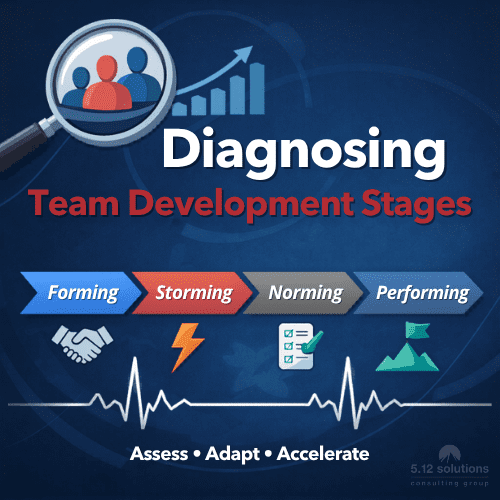
Our team acceleration work organizes team development stages into four clear phases. Each stage demands different leadership strategies.
- Forming & Dependent | At this stage, team members rely heavily on the leader for direction and reassurance. Decision-making is slow, and people are hesitant to share opinions for fear of judgment. The focus here is on building connection and establishing psychological safety.
- Storming & Conflicted | Teams begin to assert opinions, and differences surface – sometimes as open conflict. This stage tests your team’s ability to handle disagreement productively. The focus is on trust, productive conflict, and clarity of roles.
- Norming & Aligned | Relationships improve, communication is more open, and team members begin to hold themselves and each other accountable. The leader’s role shifts to supporting collaboration and reinforcing shared norms and agreements.
- Performing & Self-Sufficient |Teams operate with autonomy, make fast decisions, and drive results while maintaining strong relationships. The focus here is on sustaining performance, mentoring, and continuous growth.
Each stage requires different leadership strategies. Trying to implement advanced strategies before foundational trust exists can backfire.
How to Assess Your Team’s Stage
A practical way to diagnose your team is to combine qualitative observation with a structured assessment. Consider the following diagnostic steps:
- Observe Team Interactions. Look for patterns in meetings, decision-making, and conflict resolution. Are members hesitant to speak up, or do discussions become heated?
- Measure Psychological Safety. Teams with high safety take interpersonal risks – they admit mistakes, share differing viewpoints, and ask for help without fear.
- Review Behavioral Norms. Do team members understand expectations for communication, decision-making, and accountability? Misaligned teams often revisit the same decisions repeatedly.
- Use an Assessment Toolkit. A structured assessment evaluates behaviors in areas like trust, clarity, contribution, and accountability. You can use a simple rating scale (1-5) for questions such as:
-
- “I feel safe sharing my opinion even when it differs from others.”
- “Our team follows through on commitments without constant reminders.”
- “We have clarity on roles and responsibilities.”
This gives you a clear view of where the team sits within the team development stages.
Free Team Development Assessment Toolkit
To support leaders, we built a Team Assessment Toolkit designed to help you diagnose team performance quickly and clearly. It includes sections to evaluate:
- Connection & Trust – Do team members feel valued and understood?
- Clarity & Roles – Are responsibilities and expectations clear?
- Conflict & Communication – Is debate productive and respectful?
- Accountability & Results – Does the team follow through effectively?
Leaders can share this survey with team members, compile results, and identify patterns. Teams scoring low in trust or clarity may need coaching and team-building exercises. Teams scoring high can focus on optimizing decision-making and delegation.
Applying Your Insights
After you diagnose team performance, the next move is intentional action.
- Forming Teams: Prioritize connection exercises, safe spaces for dialogue, and structured onboarding.
- Storming Teams: Introduce conflict resolution frameworks, clarify roles, and model productive debate.
- Norming Teams: Reinforce accountability, celebrate wins, and ensure feedback loops.
- Performing Teams: Focus on leadership coaching, cross-team collaboration, and strategic growth initiatives.
At 5.12 Solutions, our Team Acceleration Programs integrate assessments, coaching, and behavioral measurement to move teams faster through these stages, turning challenges into measurable performance gains.
Why a Human-Centered Approach Matters
Our research shows that the most effective teams aren’t just technically skilled – they’re deeply human. Connection, clarity, and the sense that contributions are valued are non-negotiable. Teams that feel safe and understood are faster, more resilient, and more innovative.
A diagnostic approach paired with a human-centric strategy ensures interventions aren’t just activity – they drive real behavior change. Leaders see faster decision-making, aligned priorities, and stronger engagement.
Take Action Today
Don’t wait for dysfunction to force action. Take control now.
Use the toolkit to diagnose team performance, identify where your team sits within the team development stages, and apply the right leadership strategies to move forward.
Download Your Free Team Assessment Toolkit and put structure behind your leadership decisions.
FAQ: Diagnosing Your Team’s Stage of Development
Q1: How often should I diagnose team performance?
A: Ideally, you should evaluate your team every 3-6 months or whenever there’s a significant change in team composition or goals. Regular check-ins help you spot issues early.
Q2: Can a team regress to an earlier stage?
A: Yes. Changes in leadership, team members, or organizational priorities can temporarily push a team back to earlier stages. Continuous monitoring is key.
Q3: What’s the fastest way to move a team to the performing stage?
A: Focus on clear communication, defined roles, conflict resolution strategies, and consistent recognition of contributions. Tailoring leadership to the team’s current stage accelerates progress.
Q4: Who should use the free assessment template?
A: Team leaders, managers, HR professionals, and project managers can benefit from this tool to understand team dynamics and implement effective strategies.