
How Can Understanding Communication Styles Improve Team Performance?
Strong Teams do not usually struggle because people lack skill, intelligence, or commitment. More often, they struggle because capable people interpret the same conversation in different ways.
One leader hears urgency. Another hears risk.
One Team member hears thoughtful collaboration. Another hears delay.
One person thinks they are being clear and direct. Someone else experiences the same communication as rushed, dismissive, or incomplete.
That is why understanding communication styles is not a “soft skills” exercise. It is a practical leadership tool for improving Team Performance, reducing rework, and helping people work through pressure with less friction.
This article breaks down why high performers often misunderstand each other, how to use DiSC without labeling people, and how leaders can reduce rework by clarifying expectations early. The central point is simple, people usually do not clash because of competence, they clash because of style differences they have not learned how to translate.
Why High-Performing Teams Still Miscommunicate
A Team can be full of smart, experienced, motivated people and still run into communication problems.
You may see it in:
- Decisions that get revisited after everyone thought they were settled
- Work that has to be redone because people heard different priorities
- Side conversations after meetings
- Tension between departments
- Frustration that gets misread as resistance, impatience, or lack of commitment
- Leaders assuming negative intent when the real issue is different wiring
The cost is not theoretical. Grammarly’s 2024 State of Business Communication report found that poor communication contributes to increased stress for 51% of workers, lower productivity for 41%, strained relationships for 31%, and missed deadlines for 26%. (Grammarly)
That data matters because communication breakdowns rarely stay contained inside one conversation. They spread into execution, morale, deadlines, and decision quality.
When leaders dismiss communication style differences as personality quirks, they miss one of the easiest places to improve performance.
Communication Styles Are Performance Signals, Not Personality Labels
Communication styles describe how people tend to process information, make decisions, respond under pressure, and interact with others.
They are not boxes. They are not excuses. They are not permanent identities.
They are signals.
A person who wants direct communication may not be rude. They may be trying to create momentum.
A person who asks more questions may not be resisting. They may be trying to reduce risk.
A person who slows down a decision may not lack urgency. They may be trying to protect alignment.
A person who wants data may not be difficult. They may be trying to prevent errors.
This is where many Teams get stuck. They react to the surface behavior instead of understanding what might be driving it.
The better leadership question is not, “Why are they being difficult?”
The better question is, “What does this person need in order to engage productively?”
That shift moves a Team from judgment to translation.
What Is DiSC, and How Does It Help Team Communication?
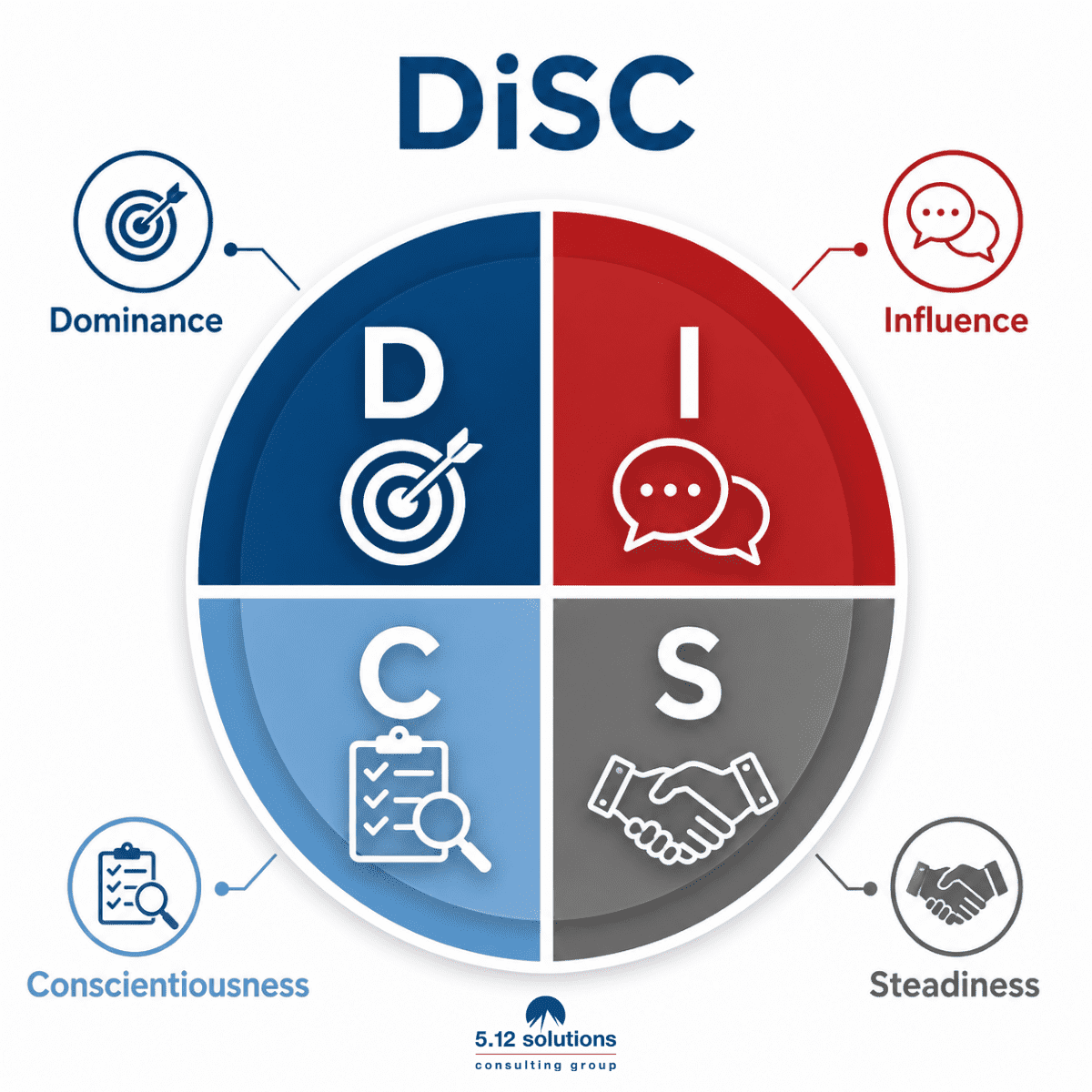
DiSC is a personality style profile that helps Teams better understand behavioral tendencies, motivations, and communication preferences. The model includes four primary styles:
- Dominance
- Influence
- Steadiness
- Conscientiousness
Most people are a blend of all four styles, but they tend to rely on one or two styles more often, especially under pressure. Sal emphasizes that DiSC should be used as a shared language for understanding behavior, not as a label that replaces thinking.
That distinction is important.
When DiSC is used poorly, Teams say things like:
“She’s a D.”
“He’s an S.”
“That’s just how C styles are.”
And then the thinking stops.
That is not insight. That is shorthand with a confidence problem.
When DiSC is used well, it helps people understand what others may need in order to communicate clearly, make decisions effectively, and work through pressure without unnecessary friction.
The Four DiSC Communication Styles at Work
Dominance, Direct, Fast-Paced, Outcome-Focused
People with strong Dominance tendencies often prefer direct communication. They are typically fast-paced, decisive, and focused on results. They may be motivated by challenge, change, control, and progress.
When communicating with a high-D leader or Team member, it helps to:
- Get to the point
- Be concise
- Focus on outcomes
- Demonstrate confidence and competence
- Avoid burying the main point under too much detail
The potential friction is that a Dominance style can be experienced as impatient or controlling, especially under pressure. The person may think they are creating urgency, while others feel rushed.
Influence, Energetic, People-Focused, Connection-Oriented
People with strong Influence tendencies often bring energy, enthusiasm, and connection into conversations. They tend to be fast-paced and people-oriented.
When communicating with an Influence style, it helps to:
- Bring energy
- Create connection
- Recognize contributions
- Leave room for discussion
- Connect the work to people, momentum, or shared purpose
The potential friction is that Influence styles may move quickly into ideas and possibilities before others feel grounded in the details.
Steadiness, Thoughtful, Collaborative, Trust-Based
People with strong Steadiness tendencies often prefer a more moderate pace. They tend to be calm, methodical, collaborative, and attentive to how decisions affect people.
When communicating with a Steadiness style, it helps to:
- Slow down
- Include them early
- Build trust
- Show sincere appreciation
- Give time to process change
The potential friction is that Steadiness can be misread as hesitation or lack of urgency. Often, the person is trying to protect clarity, alignment, and Team stability.
Conscientiousness, Precise, Logical, Accuracy-Focused
People with strong Conscientiousness tendencies often value accuracy, logic, structure, and data. They may prefer a moderate pace and want to understand the reasoning behind a decision before moving forward.
When communicating with a Conscientiousness style, it helps to:
- Bring data
- Be precise
- Explain the logic
- Avoid vague claims
- Give them time to evaluate
The potential friction is that Conscientiousness can be misread as resistance or over-analysis. In reality, the person may be trying to prevent mistakes.
A Common Team Breakdown, Same Goal, Different Approach
Sal gives a practical example of a high-D leader and a Steadiness-style leader working toward the same goal but approaching it differently.
The high-D leader wants speed. They may be thinking, “Why are we moving so slowly?”
The Steadiness-style leader wants alignment. They may be thinking, “Why are we rushing before everyone is clear?”
Neither person is necessarily wrong. They are filtering the situation through different communication styles and leadership priorities.
Without a shared language, this difference can turn into frustration. With a shared language, the Team can name the difference without making it personal.
A useful phrase is:
“I think we are aligned on the outcome, we just have different approaches to getting there. Let’s slow down and talk through what each of us is seeing.”
That sentence does a lot of work. It acknowledges shared intent, names the difference, and creates space to discuss the process before friction hardens into blame.
The Fastest Way to Reduce Rework, Clarify Before You Move
Rework often starts long before the work is actually redone.
It starts when people leave the same meeting with different assumptions.
One person thinks the decision is final. Another thinks it is still being discussed.
One person thinks speed matters most. Another thinks stakeholder buy-in matters most.
One person thinks success means getting something shipped quickly. Another thinks success means getting it right the first time.
This is where leadership clarity matters.
Gallup reported that in 2024, only 46% of U.S. employees clearly knew what was expected of them at work, down from 56% in March 2020. (AP News)
That decline creates a serious opening for misinterpretation. When expectations are unclear, people fill in the blanks using their own communication style, role priorities, and pressure response.
The fix is not complicated, but it does require discipline.
Before moving forward, leaders should clarify:
- What success looks like
- How the decision will be made
- Who needs to be included
- How the decision will be communicated
- What tradeoffs the Team is willing to make
A simple leadership question can prevent a pile of downstream confusion:
“Before we move forward, can we align on what success looks like, how the decision-making process will happen, and how we are going to communicate it?”
That question may feel basic. It is also the kind of basic that saves three meetings, two Slack threads, and one very tired project manager.
Poor Communication Turns Leaders into a Cleanup Crew
When communication breaks down, leaders often get pulled into work they should not need to manage.
Axios HQ reported that 48% of leaders have gotten more involved in projects than they should have because of ineffective communication, and 43% spend too much time clarifying or reinforcing communication with staff. (Axios HQ)
That is not just inefficient. It pulls leaders away from strategy, coaching, prioritization, and decision-making.
The problem is not that leaders should communicate less. It is that Teams need better-quality communication earlier in the process.
More messages will not fix unclear expectations.
Additional meetings will not fix unspoken decision rules.
Extra reminders will not fix different assumptions about success.
The better move is to create shared understanding before the work begins.
Decision Clarity Improves Team Performance
Communication styles do not only affect relationships. They also affect decision-making.
McKinsey found that Teams scoring above average on decision-making were 2.8 times more innovative than Teams scoring below average. (McKinsey & Company)
That connects directly to the point about deciding how decisions will be made before style assumptions get in the way.
If a Team does not clarify decision rights, communication norms, and success criteria, each person may default to their own preferred style.
- The Dominance style may push for speed.
- The Steadiness style may push for inclusion.
- The Conscientiousness style may push for more data.
- The Influence style may push for buy-in and momentum.
All of those instincts can be useful. None of them should quietly run the process by default.
Strong Teams make the process visible.
Great Leaders Adapt Their Communication
One of the biggest mistakes leaders make is assuming their natural communication style should work for everyone.
It will not.
Direct leaders may be effective with people who value speed but may lose people who need context.
Relational leaders may build trust but frustrate people who want a decision.
Data-focused leaders may protect quality but overwhelm people who need the headline first.
An inclusive leader may create buy-in, but slow people down when urgency is truly required.
The goal is not to abandon your natural style. The goal is to know when that style is helping and when it is getting in the way.
Great leaders become more multidimensional. They learn to flex based on the person, the pressure, and the moment.
That is not inauthentic. That is effective.
Common Mistakes Teams Make with DiSC
Mistake 1, Labeling People
DiSC becomes less useful the moment Teams turn it into a labeling system.
The point is not to say, “He is a D,” and move on. The point is to understand what behavior may show up under pressure, what that person may need, and how to communicate in a way that improves the interaction.
Mistake 2, Expecting Others to Adapt First
Another mistake is using DiSC to explain why everyone else should change.
That misses the leadership opportunity.
Leaders cannot control how other people think, communicate, or respond under pressure. They can control how they prepare, adapt, clarify, and follow up.
Mistake 3, Using DiSC Once and Forgetting It
Many Teams complete a DiSC workshop, discuss the results, and then never use the language again.
That is not integration. That is an event.
DiSC becomes useful when leaders apply it in daily work:
- Preparing for one-on-one conversations
- Planning Team meetings
- Navigating conflict
- Clarifying decisions
- Onboarding new leaders
- Debriefing communication breakdowns
- Improving cross-functional collaboration
Used consistently, DiSC becomes part of how a Team thinks and works.
DiSC Communication Styles Are Not the Whole Answer, But They Are a Smart Place to Start
Understanding DiSC communication styles will not fix every Team problem. It will not replace accountability, strategy, role clarity, or strong leadership judgment.
But it gives Teams a practical way to reduce preventable friction.
When people understand style differences, they are less likely to misread intent. When leaders clarify expectations early, they reduce rework. When Teams create a shared communication language, they improve the way decisions are made, shared, and executed.
High-performing Teams do not need everyone to communicate the same way.
They need people who can translate.
Better Team Performance Starts with Better Communication
Your high performers are not always the problem. Often, they are simply speaking different work languages.
DiSC gives leaders and Teams a shared language for understanding those differences. It helps explain why one person pushes for speed, another asks for alignment, another needs data, and another wants connection.
Used well, DiSC does not label people. It helps people adapt.
And that is where Team Performance improves, not by pretending communication differences do not exist, but by helping people work across them with more clarity, intention, and trust.
For leaders who want to reduce rework, improve collaboration, and build stronger working relationships, the next step is simple, start paying attention to the style behind the words.
Then lead the conversation with more intention.
Ready to apply DiSC with your Team?
Download our free DiSC Kickstarter Toolkit to start identifying communication styles, adapting your leadership approach, and reducing friction in day-to-day conversations.
Get the free DiSC Kickstarter Toolkit:
📌 https://512solutions.com/disc-toolkit/
FAQ on Communication Styles and Team Performance
Q: What are communication styles in the workplace?
A: Communication styles are the patterns people use when sharing information, making decisions, responding under pressure, and working with others. Understanding these styles helps leaders reduce misunderstandings, improve collaboration, and communicate in ways different Team members can receive and act on.
Q: How does DiSC improve Team communication?
A: DiSC improves Team communication by giving people a shared language for understanding behavioral tendencies. It helps leaders recognize how different people may prefer to receive information, make decisions, process change, and respond under stress. The goal is not to label people, it is to improve communication and reduce friction.
Q: What are the four DiSC communication styles?
A: The four DiSC styles are Dominance, Influence, Steadiness, and Conscientiousness. Dominance is often direct and outcome-focused. Influence is energetic and people-focused. Steadiness is thoughtful and collaborative. Conscientiousness is precise, logical, and accuracy-focused.
Q: Why do high-performing Teams still have communication problems?
A: High-performing Teams often have communication problems because talented people can interpret the same conversation differently. Style differences, unclear expectations, different decision-making assumptions, and pressure responses can all create friction, even when everyone is capable and committed.